One Bite at a Time

August 30, 2013

How do you eat an elephant? The old time management answer is: one bite at a time. Our printed Bibles may seem like a thousand page plus elephant. The reality is that the Bible is a library of books, none of which are very large. Most books of the Bible could be read in an evening. Individual books if printed separately would seem pamphlet sized. None would be as big as a best-selling, paperback novel.
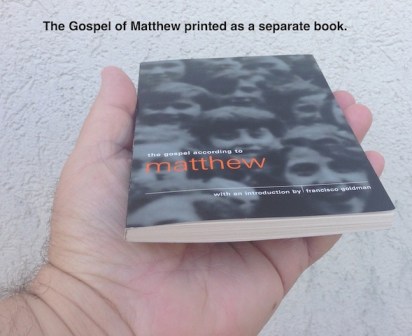
Matthew as a separate book

The following chart is based on an audio version of the Bible. I realize reading times vary. Silent reading is usually faster than reading aloud, yet most of us probably stop and think about what we are reading. We may reread a section. We may be interrupted. All of this slows us down. Faster is not necessarily better. The following chart is simply a guideline. The chart is to encourage you to begin to take one bite at a time.

Bible books that can be read in 15 minutes or less.
Ruth, Song of Solomon, Joel, Obadiah, Jonah, Nahum, Habakkuk, Zephaniah, Haggai, Malachi, Philippians, Colossians, 1 Thessalonians, 2 Thessalonians, 1 Timothy, 2 Timothy, Titus, Philemon, James, 1 Peter, 2 Peter, 2 John, 3 John, and Jude.
Total 24 out of 66 books.

Bible books that can be read in 30 minutes or less.
Esther, Ecclesiastes, Lamentations, Amos, Micah, Galatians, Ephesians, and 1 John.
Total 8 books giving us a running total of 32 books out of 66.

Bible books that can be read in one hour or less.
Ezra, Nehemiah, Daniel, Hosea, Zechariah, Romans, 1 Corinthians, 2 Corinthians, and Hebrews.
Total of 9 books giving us a running total of 41 books out of 66.

Bible books that can be read in 1½ hours or less.
Joshua, Judges, and Revelation
Total 3 books giving us a running total of 44 books out of 66.

Bible books that can be read in 2 hours or less.
Leviticus, Deuteronomy, 1 Samuel, 2 Samuel, 1 Kings, Job, Proverbs, Matthew, Mark, John, and Acts.
Total of 11 books giving us a running total of 55 books out of 66.

Bible books that can be read in 2½ hours or less.
Exodus, Numbers, 2 Kings, 1 Chronicles, and Luke
Total 6 books giving us a running total of 61 books out of 66.

Bible books that can be read in 3½ hours or less.
Genesis, Isaiah, and Ezekiel
Total of 3 books giving us a running total of 64 books out of 66.

Bible book that can be read in 4 hours or less.
Jeremiah
Total of 1 book giving us a running total of 65 books out of 66.

Bible book that can be read in 4½ hours or less.
Psalms
Total of 1 book giving us a running total of 66 books.


The Frustrations of Bible Reading

August 2, 2013

The average American household has four Bibles or more. We are a long way from the times before the invention of the printing press when Bibles were expensive and rare. But having access to a Bible doesn’t necessarily mean Americans are Bible readers. A recent press release from Logos Bible Software provides these statistics about Bible reading among church attenders.1

  • 18–34% Rarely or never read the Bible
  • 12% Felt confused the last time they read the Bible
  • 11% Felt overwhelmed
  • 40% Felt an “unfavorable emotion”

Survey respondents also indicated their top frustrations with Bible reading.

  • 32% “I never have enough time”
  • 12% “The language is difficult to relate to”
  • 11% “I don’t feel excited about reading it”

Is reading the Bible frustrating? The answer is yes — at least initially. Everyone who develops the habit of regular Bible reading struggles to find time to read. It becomes easier, but I still go through busy times in my life when I play catch up on my reading guide. We also need to keep things in perspective. None of the books of the Bible are very long. Most are pamphlet size if they were printed by themselves. Each of the gospels could be read aloud in about two hours. In comparison, one of the most recent John Grisham novels would take nearly 13 hours read aloud — the entire New Testament could be done in about 16 hours.

I think most new Bible readers do feel confused and struggle to understand. I liken my first time reading through the Bible with fishing with a net with holes six inches wide. You can catch a big fish with it — some of the big ideas in the text, but many things will pass right through. Fishing with such a net would obviously be frustrating. Each time through the Bible your net becomes finer, and you “catch” more of what is in the text.

I suspect that talking about the frustration of Bible reading seems a bit sacrilegious. After all, the Bible is God’s word. How can we complain about God’s word? Yet, I know of few things in life that don’t entail a learning curve especially if they are worth doing. Admitting our frustrations is the first step in moving beyond them. Knowing that others have felt the same way in their journey can help us work through our own frustrations. Believe me when I say the journey is worth it.

1http://www.logos.com/press/releases/free-esv-bible. Note that the press release is about a free ESV Bible for iOS, Android, or Kindle Fire mobile devices. The free offer is good through August 10th. Use the press release link to find the offer. Logos is one of the Bible apps that I personally use on my iPad, and free is hard to beat.


Don’t Smoke the Book of John

June 28, 2013

Why are our Bibles so portable? The Bible is a library of sixty-six books. In scrolls, it would be difficult to impossible to carry around. The book form or codex was introduced to the world in the first century. By the second century, we have evidence that the codex became the preferred format for early Christians.

The book format allows a lot of material to be carried in a handy size. The last page of Revelation in my Bible is on page 1252, yet it is only about an inch and half thick. A best-selling novel of 650 pages can be nearly two inches thick. Why are our Bibles as thin as they are? Most Bibles are printed on thin paper.

That leads us to the odd news. The German Bible Society distributes about 400,000 Bibles per year. According to Felix Breidenstein, the society’s business manager, the Chinese craving for cigarettes is driving up the price of Bible production. The rising demand for cigarette paper in China means stiffer competition for the thin paper used in Bible printing. So if you need another reason to quit smoking other than it can kill you, it also drives up the price of Bibles.

Bible paper and smoking have another link. Prisoners have on occasions used pages of the Bible to roll their own cigarettes. The World Bible Translation Center tells one such story. Thirty years ago a prisoner was using his Bible to roll cigarettes. Another inmate squealed on him. But surprisingly, the chaplain gave the man another copy of the Bible. But he left with this admonition: “Don’t smoke the book of John.”

The prisoner continued to roll cigarettes, but respected the charge. He didn’t smoke the gospel of John, but began to read. He learned of God’s great love in sending His Son. He learned of the choice between eternal life and perishing, and he chose life. The prisoner was converted and now serves as chaplain at three different jails in Texas. He recently baptized 15 and has distributed 300 Easy-to-Read New Testaments in the past year.

How odd that Bibles and cigarettes are in competition for the same paper! China attempts to restrict religion to government-authorized religious organizations and registered places of worship. Persecution exists. My prayer for the Chinese is that they also discover the best use of thin paper – the Bible.


Not By Bread Alone

December 14, 2012

I’m a regular Bible reader. The guide I use has daily readings for the whole year, and I should be able to finish it without problems. I’ve done so for years now. But I confess that I miss days at times. I try to read ahead when I can, and I play catch up when necessary. Bible reading has become a regular part of my life. But I avoid the term “daily” because I suspect that all of us who develop the habit of Bible reading slip up. I don’t want to set perfection as the standard for the person who has not yet developed the habit.

The beginning of the year is important to me as the time to set my goal for Bible reading in the next year. Starting the habit of Bible reading doesn’t require the beginning of a new year. The habit can be started at any time. But I have found that a new year has been a helpful time to start. The new year can provide motivation to form a new habit.

I have failed in my reading goals in the past, although I currently have years of consistency behind me. I suspect most people who successfully form the habit of being a regular Bible reader have had some failures along the way. Forming habits is not always easy. Life has many distractions. Research indicates that it takes a couple of months to form a habit. But we have to be careful to be consistent or we can unlearn a habit. Don’t let past failures stop you from trying. This habit is worth it.

For me forming the habit of regular Bible reading did not start with a daily Bible reading guide. I started smaller. I started with smaller goals with the commitment to try to read daily. (Note the word “try.” I tried for consistency not perfection. Forgiveness allows us to keep trying.) For example, I started first with the commitment to read the gospels. After I reached that goal, I made the commitment to read the rest of the New Testament. It is good to read through the historical portions of the Old Testament (Genesis through Esther). A simple reading log can track your progress.

The Bible reading guides that I have liked the most through the years have provided some variety in reading. I’ve done better with reading guides that gave at least an Old Testament and a New Testament reading each day. The guide that I have used the most through the years is the M’Cheyenne guide. It gives four different readings each day. Variety is helpful. It’s tough to plod through Leviticus or the first nine chapters of 1 Chronicles. Having other passages to read really helps, because it ensures some spiritual nourishment in your reading. (Not that there are not lessons in Leviticus and the genealogies of 1 Chronicles. They just may be harder to recognize for the beginning reader.)

Bible reading is not just about reading. It is good to write down questions of things you don’t understand. In time, your reading may help you answer those questions. I’ve just had one answered that I have pondered for about forty years. Most questions probably won’t take that long to be answered. The most important things in scripture will be clear. Yet there is always something to be pondered. A quotation that goes back at least fourteen centuries suggests that the Bible is like a river “shallow enough for the lamb to go wading, but deep enough for the elephant to swim.”

A few simples tools can help. A Bible dictionary is helpful for looking up words that you don’t know the meaning of, and a map is helpful for locating places. These simple tools can enrich your reading experience.

It is also important to reflect on how this applies to me. Bible reading is about a transformational relationship with God. It has changed me as a person. It is not just about the head but the whole inner person. “… man does not live on bread alone but on every word that comes from the mouth of the Lord” (Deuteronomy 8:3, NIV).


My Greatest Possession

August 12, 2012

In the movie, Luther, there is a memorable scene between Martin Luther and the vicar of the Augustinian order where Luther was a monk, Johann von Staupitz. Luther wrestled with spiritual uncertainty. He was always conscious of his sin. He knew that he could never be good enough. He doubted his salvation. Von Staupitz asks him, “Have you ever read the New Testament?” Luther answers, “No.” Von Staupitz informs him that he should study for his doctor’s degree which would ultimately mean he would replace von Staupitz as the Bible chair in the University of Wittenberg.

What is striking is that Luther had never read the New Testament! He had grown up in a religious home. He had studied to become a lawyer, and after a spiritual crisis, he became a monk. The New Testament had been available in Latin and Greek, but as Roland Bainton notes in his biography of Luther, “…the Bible was not the staple of theological education.” And the New Testament was certainly not available to the common man. Bainton reflects, “One is tempted to surmise that [von Staupitz] retired in order unobtrusively to drive this agonizing brother to wrestle with the source book of his religion.”1

Luther’s wrestling with the source book ignited the Reformation and brought him in conflict with church officials. At the Diet of Worms, he made his famous confession, “Unless I am convicted by Scripture and plain reason—I do not accept the authority of popes and councils, for they have contradicted each other—my conscience is captive to the Word of God.” Those were dangerous words in 1521. Frederick the Wise, elector of Saxony, took Luther to the Wartburg Castle for safety. While there Luther translated the New Testament into German (1522). The entire German Bible was completed by 1534. With Luther’s influence, William Tyndale produced the first printed English New Testament in 1525. The Bible was given back to the common person.

The home I grew up in had several Bibles. I’ve had my own Bible since early elementary school. I read the New Testament as a teenager. Ninety-two percent of all Americans have at least three Bibles at home. I marvel at the technology that allows me to carry a Bible (actually multiple translations) around in my shirt pocket. We live with a surplus of Bibles, but history reminds us that it hasn’t always been that way.

With the surplus of Bibles, it is easy to take them for granted. In fact, we have so many physical blessings; it is difficult to count them all. But the lessons of history cause me to reflect. My greatest physical possession is my Bible. It is my greatest treasure, because it teaches me the words of life.

1Roland Bainton, Here I Stand: A Life of Martin Luther, p. 60


Why Read the Bible

December 30, 2011

How have you done in regular Bible reading? I’ve just finished my Bible reading plan for 2011. I read through the Bible in the KJV in celebration of the 400th anniversary of the KJV, and I also read the New Testament and Psalms in the 2011 edition of the NIV. I’m in the process of planning my reading for 2012. It doesn’t take the beginning of a new calendar year to plan to read the Bible, but it is a convenient time to think about it.

Regular Bible reading is a great privilege. We have easy access to the Bible. Some of you may even have a Bible on your smart phone that you carry in your pocket or purse. With that kind of convenience, you can take advantage of the unexpected waiting that comes to all of our lives.

Why read the Bible? We worship a God who has revealed himself in the words of scripture. We come to know someone through words. We listen to one another’s conversations. We read letters. We read articles and books. Just think how limited we would be if all of life’s communications were like a game of charades. Given the importance of words in general in knowing another, it is not surprising that we come to know God through his self revelation in scripture. Coming to know God through the Bible is consistent with his nature.

The Bible is also central to Christian instruction. Paul states:

All Scripture is breathed out by God and profitable for teaching, for reproof, for correction, and for training in righteousness, that the man of God may be complete, equipped for every good work. 2 Timothy 3:16–17, ESV

Paul also affirms that moral transformation which is a goal of Christian living is achieved by the renewal of our minds (see Romans 12:1-2). Although it is possible to read the Bible and not be transformed morally, since it is an activity that must be approached in faith, it is impossible to have moral transformation as God desires without the words of scripture guiding us.

Finally, the Bible contains God’s dealing with his people. We read about God’s unfolding plan and mission for his people in the world. N.T. Wright notes scriptures’s relationship with our mission in the world.

The idea of reading a book in order to be energized for the task of mission is not a distraction, but flows directly from the fact that we humans are made in God’s image, and that, as we hear his word and obey his call, we are able to live out our calling to reflect the creator into his world.*

Many reasons exist for regular Bible reading. Make your plans today.

*N.T. Wright, The Last Word, p. 34.


How to Read Psalm 119

October 28, 2011

To be a Bible reader is to read poetry. Someone has estimated that sixty percent of the Old Testament is in poetic form. Poetry also occurs in the New Testament. The basic marker of Hebrew poetry is parallelism. The two parallel lines will say the same thing in different words, or say contrasting things, or sometimes the second line will build on the first.

The longest poem in Psalms is Psalm 119. I have to admit in the early days of my Bible reading I would feel a little dread of Psalm 119. It is so long! It is twenty-two stanzas and 176 verses long. Even then, it was easy to recognize some high points in the psalm:

How can a young man keep his way pure? By guarding it according to your word. Psalm 119:9, ESV

I have stored up your word in my heart, that I might not sin against you. Psalm 119:11, ESV

Your word is a lamp to my feet and a light to my path. Psalm 119:105, ESV

Yet 176 lines is a long way to go for a few choice nuggets. I recognized some familiar trees, but I didn’t have a sense of the beauty of the entire forest.

I wasn’t alone. Some unkind things have been said about the psalm by commentators through the years. Some have felt that the poem is disjointed. Yet to be a Bible reader is to read and to read again. In time, I’ve come to appreciate the psalm as a whole and to see its beauty.

Psalm 119 is a tightly structured poem. It is an acrostic poem. The twenty-two stanzas of the poem are usually marked in English with each letter of the Hebrew alphabet. Hebrew has only twenty-two letters in its alphabet. That means that each of the eight lines in the stanza begin with that letter of the Hebrew alphabet. Eight lines beginning with the same letter and a stanza for each letter of the alphabet is a challenging task. The poem uses the word law (Hebrew torah which also means instruction) and seven synonyms for law. Likely the reason for 8 lines per stanza is the fact that the psalm uses 8 words for law. One of these 8 words for law occurs in every line except four, but in five lines of the poem a synonym for law occurs twice.

What helped my reading of this psalm? Read through the psalm and look for the circumstances of the psalmist. Read through the psalm and look for the petitions of the psalmist. Read through the psalm and look for the things he says about law or instruction and its benefits. Read through the psalm and look for praise of God. Do this and I think your appreciation for the psalm will grow. You will see its lament, wisdom, and praise. You will see how the whole psalm fits together in a wonderful way.


NIV 2011

February 18, 2011

The print edition of a major update to the NIV is expected to be released in March 2011. Electronic versions of this new edition are already available. The new edition is simply called the NIV. In order for consumers to know which edition they are purchasing, they will have to check the copyright notice in the front. The previous edition ended with a copyright date of 1984. The new one will have a date of 2011. Zondervan expects to move all of their NIV products to the new edition over the next two years. After the release of this new edition, the 1984 edition of the NIV and the TNIV will no longer be published.

The path to this updated version has been bumpy and controversial. Two previous editions met with criticism — the NIVI released in Britain (the “I” stood for inclusive) and the TNIV (the “T” stood for “Today’s”). The debate centered on gender inclusive language. Most modern translations (e.g., NKJV, NASB, and ESV) attempt to be somewhat gender neutral. The question is the extent to which this may legitimately be done. For example, sometimes “brothers” may include women, but not always. The new NIV frequently uses “brothers and sisters” where the Greek has “brothers.” But there are situations where it may be difficult to know whether women should be included. For example, the new NIV has “believers” for “brothers” in Acts 14:23 for the group that travelled with Peter to Cornelius’ house. Controversy also erupts over changing singular masculine pronouns like “he” to plural pronouns like “they.”

“Jesus replied, “Anyone who loves me will obey my teaching. My Father will love them, and we will come to them and make our home with them. ” (John 14:23, NIV 2011, my emphasis)

“Here I am! I stand at the door and knock. If anyone hears my voice and opens the door, I will come in and eat with that person, and they with me. ” (Revelation 3:20, NIV 2011, my emphasis)

We end up with singular pronouns being mixed with plural pronouns referring to the same person. Other passages to notice are that Phoebe becomes a “deacon” in Romans 16:1, and women are told not to “assume authority” rather than “have authority” in 1 Timothy 2:12. These are passages that are likely to spark discussion.

The new NIV has responded to some of the criticisms of the NIVI and TNIV and pulled back a bit from those editions, but it remains to be seen whether it is enough to avoid controversy and gain the same level of use. Readers of the Bible need to understand how to distinguish the previous NIV from the new one and the nature of some of the changes. Readers of “thought for thought” translations like the NIV are wise to compare with more “word for word” translations to see if we indeed have God’s thoughts and not just the thoughts of a translation committee.


The Parable of $100,000

February 13, 2011

The Bible reader must be careful. The message must be properly understood and not distorted.

Sometimes passages do need further enlightenment that will change our perspective. This may come from taking into account all that scripture says on a subject, allowing scripture to interpret scripture. It may arise from new insights gained from history, customs, geography, understanding literary forms, or the biblical languages.

Yet, there is also the danger that we will fail to understand and apply simply because we don’t like what it says—our own willfulness gets in the way. Maybe scripture challenges our beliefs and attitudes, and we shrink away. Søren Kierkegaard told a challenging little parable of $100,000:

Suppose that it was said in the New Testament—we can surely suppose it—that it is God’s will that every man should have 100,000 dollars: Do you think there would be any question of a commentary? Or would not everyone rather say, “It’s easy enough to understand, there’s no need of a commentary, let us for heaven’s sake keep clear of commentaries—they could perhaps make it doubtful whether it is really as it is written. (And with their help we even run the risk that it may become doubtful.) But we prefer it to be as it stands written there, so away will all commentaries!”

But what is found in the New Testament (about the narrow way, dying to the world, and so on) is not at all more difficult to understand than this matter of the 100,000 dollars. The difficulty lies elsewhere, in that it does not please us—and so we must have commentaries and professors and commentaries: for it is not a case of “risking” that it may become doubtful to us, for we really wish it to be doubtful, and we have a tiny hope that the commentaries may make it so.

Let us be careful readers and students of the Bible searching for the truth (see Acts 17:11). Yet, let us not protect our hearts from scripture’s rigorous demands, but allow it to challenge and change us. “For the word of God is living and active and sharper than any two-edged sword, and piercing as far as the division of soul and spirit, of both joints and marrow, and able to judge the thoughts and intentions of the heart” (Hebrews 4:12, NASB).


Swimming with Elephants

December 10, 2010

Developing the habit of Bible reading is not always easy. The beginning reader may at times feel overwhelmed by the Bible. A quotation that I’ve heard in various forms dates back at least fourteen centuries.

Scripture is like a river again, broad and deep, shallow enough here for the lamb to go wading, but deep enough there for the elephant to swim.

Why do we at times feel like we are swimming with elephants with the water way over our head? Consider the following. The Bible has thousands of names for people and places. The dictionary Pronouncing Bible Names gives 3,492 proper names from the KJV, and many of these names are admittedly difficult to pronounce. The Bible has plenty of common nouns that we don’t use in everyday conversation, like atonement, propitiation, righteousness, and mercy. The Bible covers over two millennia of history. The geography of the Bible is not ours. The cultures and customs of the Bible are distant from ours.

So how do we begin? We wade. We begin with those portions of the Bible most relevant to us and possibly the easiest from which to gain something: the gospels and Acts. Then read the epistles. If nothing else, you will learn the ethics of the Christian life. As you wade into deeper water, you add the narrative portions of the Old Testament (Genesis through Esther). Once you have all the narrative of the Bible read, you will understand the flow of Bible history. You can add the wisdom literature of the Old Testament (Job through Song of Solomon). And finally, read the prophetic books of both testaments (Isaiah through Malachi, and then Revelation). And then repeat, and repeat, and repeat.

You will have questions and things you don’t understand. Write them down, but keep reading. The Bible is its own best interpreter. You will be amazed at how many of your own questions you can answer by continuing to read.

Have a dictionary handy. It is good to have a Bible dictionary because it specializes in Bible words, but a regular dictionary is helpful too. I’m an avid reader, but there hasn’t come a point in my life where I didn’t have to look up certain words to find out what they mean.

Recognize that this is a process that takes time. The more I read the Bible, the more I grasp of it. It begins by wading. But in time you find yourself in the deep water swimming with elephants discovering the wonder of thinking God’s thoughts after Him.