What Are Strong’s Numbers?

August 15, 2014

Strong’s Exhaustive Concordance of the Bible was first published in 1890. It is a concordance of the King James Version. The concordance was compiled under the direction of Dr. James Strong, but more than 100 colleagues aided in the production of the concordance. Produced in the nineteenth century everything had to be done by hand. It was a very labor intensive project, but it has been useful to Bible students ever since.

The unique feature of this concordance was that it exhaustively cross-referenced every English word of the KJV with the word in the original languages. Each word in Hebrew and each word in Greek were assigned a number. These numbers are known as Strong’s Numbers.

Strong’s numbers allow the English readers to get back to the original language without knowing Hebrew or Greek. If they are curious about a particular word, they can look up the English word in the concordance, locate the verse reference, and then find the Strong’s number. This number tells them what original language word stands behind the English translation. With the number, the word can be looked up in the Hebrew and Greek dictionaries at the back of the concordance. This feature is helpful in digging deeper in a passage, evaluating translations, and doing word studies.

With a Strong’s number a student can do a word study on the original language word. He or she could find every occurrence of the particular Greek or Hebrew word regardless of how it may be translated. Most translations render the same Greek or Hebrew word with some variety due to the range of meaning each word has. But doing a word study on the original language word may help the reader see this range of meaning. It may help the reader see connections within the text that become lost in translation.

For example in John 21:15-17, John uses two different Greek words for love in Jesus’s question and Peter’s reply. Does that have significance or not? Some say that it does. I tend to think it is just a case of synonyms, and the main concern is that the question is asked three times (reminiscent of three denials). By using Strong’s Numbers a reader could look at John’s use of these two words for love in the entire gospel.

Strong’s numbers have been applied to translations beyond the KJV. The numbers have also become searchable in some Bible software packages and apps (e.g., Logos, Accordance, and Olive Tree Bible Study App to name a few). In computer-based searches, the search can be done much more quickly than with Strong’s Concordance and looking up all the references by hand in a Bible.

In addition some dictionaries and word studies use Strong’s numbers, so the reader can find additional information (e.g., Mounce’s Complete Expository Dictionary, Theological Wordbook of the Old Testament (by Harris, Archer & Waltke), or The New International Dictionary of New Testament Theology: Abridged Edition.)We are blessed with tools that help us carefully look at the text of the Bible.


A Well-Worn Bible

June 20, 2014

A Well-Worn Bible

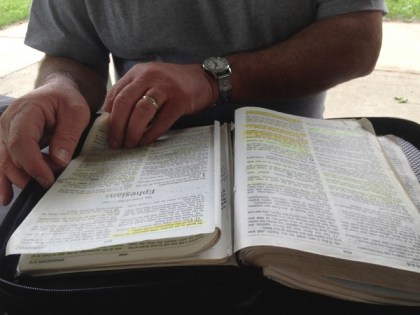
Our church met in a park last Sunday night, and I snapped the above photo of one our elder’s Bible before he spoke. You notice his Bible is marked and falling apart. It reminds me of the Charles Spurgeon quote: “A Bible that’s falling apart usually belongs to someone who isn’t.” A well-worn Bible is what you want to see in a church leader.

I still think he needs a new one, but he is going through the trauma that I have also experienced. I had a wide margin Bible that was beginning to fall apart after a decade of use. I knew the bookstore manager and asked him about the lifetime guarantee. He would gladly give me a new Bible if I turned in my old one. I couldn’t part with it, although I did move to a new one. You spend years with a Bible making notes in it. You have treasures in your margins that you don’t want to loose. Notes and underlining are a way of making the book your own.

I read a publishing statistic somewhere. A paperback Bible is expected to last one year of daily use. A hardback Bible is expected to last five years, and a leather bound Bible is expected to last 10 years of daily use. Leather is not to make the Bible into a religious relic. It is used because it makes for a durable binding. In fact, if you scan through any old libraries, you will find many leather bound books for that reason.

I have also seen pristine Bibles that shouldn’t have been. I once made a visit to home. The person had a Bible they wanted to show me. It was brought to me with obvious pride. It was still in the box with the white paper wrapped around it. It was like new. Inwardly, I was a bit horrified. I think I mumbled something about Bibles are to be used.

My Bible is now on my iPad. It is what I use on a daily basis. It won’t have the signs of a binding’s wear. But it still has signs of daily use: checked off Bible reading guides, highlighting, and notes.

Which is it for you? Does your Bible look new even thought it isn’t or do you too have a well-worn Bible?


Which Bible?

January 10, 2014

“Which Bible should I read?” The question is simple enough, but sometimes people ask the question with a subtext. The subtext goes something like this: there are so many different translations of the Bible, how does God expect me to sort this out? The subtext’s complaint then becomes an excuse for procrastination and inaction.

Informed Christians know that the Old Testament was written for the most part in Hebrew with a small portion in Aramaic, and the New Testament was written in Greek. That means when there are controversies over meaning, the final appeal must be to the original languages. Yet, that does not rule out the importance of translations.

Translating the Bible into various languages has been done since earliest times (for example with the New Testament into Syriac and old Latin), but it received a greater emphasis beginning in the Reformation. Most people are not going to be in the position to learn Greek and Hebrew, yet we have a great interest in knowing what God’s word says.

So what are some good guidelines for choosing a Bible translation?

  1. Choose a translation done by a committee. Committee members serve as checks and balances on one another to prevent a bias from entering the translation. Most major translation have been done by a committee, and most modern ones have had committees composed of a spectrum of Christian groups. That doesn’t mean never read a translation by an individual, and it doesn’t mean that bias can never be found in a committee translation. It rather reflects the safest place to start.
  2. Be informed about translation philosophy. There are two basic approaches to translations: formal equivalence (more word to word) and functional equivalence (more thought to thought). Most translations can be described as formal equivalent or functional equivalent. Most translations will describe their approach in the preface. Both approaches have their strengths and weaknesses. Comparing the two approaches can be valuable. It is important to know which approach you are reading. I find formal equivalence helpful for close study, but when I was a new reader of the Bible, I found the functional equivalence helpful to my fledgling understanding.
  3. You can read more than one and compare. Although most of us will choose a primary translation for reading and study, we live in a world where it is easy to compare translations. Computers and mobile devices make this especially true. I’ve learned a lot through the years comparing the two kinds of translation approaches and different translations. Sometimes differences in translations make no real difference in overall meaning. Sometimes differences reflect possible nuances in the original languages, and sometimes differences alert the reader to problems of interpretation. But having read many different translations of the Bible, my overall impression is that they are all translating the same book. We may find verses where one translation is preferable to another, but the overall, big picture message remains the same.

According to a recent listing from the Christian Booksellers Association, these are the top selling translations by units sold:

  1. New International Version
  2. King James Version
  3. English Standard Version
  4. New King James Version
  5. New Living Translation
  6. Holman Christian Standard Bible
  7. Reina Valera 1960 (if you read Spanish)
  8. New International Readers Version
  9. Common English Bible
  10. New American Standard Bible

Although I would have preferences in this list, the reality is that you could learn how to become a Christian and what you need to be saved from reading any translation on this bestseller list. Just read it!


Thank You Bible Teachers!

December 1, 2013

The truth is I can’t remember their names except for the ones when I was a teen. I can’t remember specific lessons, although fragments of classes and moments in classes do come to recollection. Somewhere along the line a class made a paper model of the tabernacle. Songs, crayons, rounded safety scissors, Elmer’s glue, and a lot of patience on the part of teachers were a part of the experience.

It was in these classes that my first knowledge of the Bible came. It was there I heard of Adam and Eve, Cain and Abel, Noah and the Flood, Abraham and Sarah, and all the other great narratives of the Bible. Flannel graph figures of Jesus and the Apostles brought to life the gospels. It was in these classes that a life long study of the Bible was born. It was in these classes that faith took root.

Bible teachers share their time and energy with students. It’s not just the time in class that teachers share. It takes time to be prepared. When you multiply 52 weeks times Sunday and Wednesday times the number of classes that we have, you realize the hundreds and even thousands of volunteer hours it takes for our Bible classes. And it is not just time, but energy too. Preparing a class and teaching a class is work, but it is rewarding work.

Bible teachers share their faith. Why bother to teach? Is it not because we believe in God and in the gospel of Jesus Christ? Our faith motivates us to share this message with others. The Bible lessons we teach are God’s message to a lost world. “So faith comes from hearing, and hearing through the word of Christ” (Romans 10:17 ESV). Even small children have the beginnings of faith. Elementary students have a great capacity to learn facts. When their ability to do abstract thinking develops around the age of 12, this great reservoir of facts is not lost, but is built upon. These basic facts can lead them to more mature understandings of God’s will. And most important of all, the students hearing the word also come to faith.

Bible teachers share their commitment. Teaching requires commitment. There is the commitment of time. There is commitment to be present at Bible studies and worship. There is the commitment to prepare and read your Bible. There is commitment to pray for your students and your class. Commitment is very important and attractive. Commitment begets commitment. Only the live ember spreads the fire.

To the Bible teachers in my life, I say thank you. To the Bible teachers of this church, I say thank you. What you share with others can influence for eternity.


Inductive Bible Study

June 8, 2012

The Restoration Movement has a plea to go back to the Bible. But what does that mean? All Christians claim Bible authority in some way. Everyone has their own proof texts. Yet, there is a problem that can exist with proof texts. The problem has to do with context.

We can easily understand the problem. Politicians and celebrities at times complain that their remarks have been taken out of context. Maybe we have even experienced it ourselves. A sound-byte of words sounds like the person is saying one thing, but when you hear or read the larger context, it means something totally different. The same problem can occur with proof texts.

How did the Restoration Movement propose to overcome this? They after all challenged their own assumptions about many beliefs. What gave them the ability to correct their own approach to the Bible? I think at least two things guided them.

First, they realized the Bible was to be read and interpreted as you would any other book. At first blush, this may sound a little disrespectful. Christians believe the Bible is inspired of God. Shouldn’t it get special treatment? The answer is that God has chosen to communicate in words, sentences, paragraphs, and books just as we would. There are no special rules for inspired writings. We have to ask the same questions as we would of any other text. What genre or kind of writing is this? We have to ask the typical reporter’s questions: who, what, when, where, and why? We must understand what is said in context.

Second, they spoke of inductive Bible study. Both J.S. Lamar in his The Organon of Scripture (1860) and D.R. Dungan in his Hermeneutics: A Text-Book (1888) spoke of inductive Bible study. In fact, the phrase is part of the subtitle of Lamar’s book. In logic, induction means reasoning from the particulars to the general. The inductive method as applied to Bible study means that you gather all the facts in the text before you draw your conclusions. That way you are allowing God to speak in context.

One of the clearest examples of this has been in our approach to becoming a Christian. Many stop at belief. Some may say belief and repentance. The Restoration Movement leaders, however, did an inductive study of the Bible. They gathered all the facts before arriving at a conclusion. When we look at all the conversion accounts in Acts and all that is said in the epistles, we conclude that one needs faith, repentance, confession of Jesus, baptism, and regeneration or new birth (which occurs at baptism when done in faith). The difference in the answer comes from gathering all the evidence.

Note: the books by Lamar and Dungan can be read online at http://www.mun.ca/rels/restmov/.