Reflections on an Old Bible

August 5, 2016

When I was at my Mom’s house, I found the Bible I had as a teenager. It was a King James Bible that my grandparents had given me as I entered my teen years. Later, I purchased a NASB right before I headed to college. The complete NASB (Old Testament and New Testament) was first published in 1971, which coincides with my high school graduation and first year of college. So somewhere along the way this old Bible was left on a bookshelf at my Mom’s house.

It was fun to look through my old Bible after so many years. It’s a bit dilapidated. I may have been rougher on it than I should have been, however, Bibles are meant to be worn out. Our frequent use of them should take a toll on them. I once read that Bible publishers suggest that the life expectancy of a bonded leather Bible is about 10 years, 5 years for a hardback, and 1 year for a paperback.

I was interested in the notes that I had placed in it. Bible knowledge is not gained in a day. It takes a life time of study. The notes that I had made as a teenager were very basic. It contained scripture references that today I probably wouldn’t need any help finding. I had written down concepts that back then I probably understood very imperfectly. For example, I misspelled the word “Pentateuch” — a word that means 5 scrolls which is normally applied to the first five books of the Old Testament, and I don’t believe that 1 Timothy has 15 chapters the last time I checked. I was told not to write in a book as a child, which meant do not write in the school owned textbook, because someone else is going to use it. We should ignore that order when it comes to books we own. One important was of learning the content of a book is underling or highlighting passages and making marginal notes.

All these notes represent an effort on my part to learn. Learning always involves effort. We cannot be passive listeners and expect to gain much from the lessons we hear. I am afraid that a verse that is true of many is 2 Timothy 3:7 — “always learning and never able to arrive at a knowledge of the truth” (ESV). Listening to sermons and Bible class lessons is not like watching television. It should not be a passive experience. Our Bibles need to be open, notes need to be taken when appropriate, and our minds need to be engaged in active listening. Active listening searches for the main points, the evidence for the points advanced, and an evaluation of the truthfulness of what is presented. A biblical example of just this sort of thing is found in the case of the Bereans in Acts 17:11: “Now these were more noble-minded than those in Thessalonica, for they received the word with great eagerness, examining the Scriptures daily to see whether these things were so” (NASB).

Finally, in looking at my old Bible I remember that I had some teachers who really cared. They worked hard at teaching. I still have taped in that Bible a handout from one of my teachers. Teaching is more than filling a 45-minute period. We are doing something that may help shape the spiritual lives of our students. It is a great responsibility. We must be students of the Word ourselves in order to be good teachers. Likely, we will have to go beyond the printed prepared materials in order to give our students everything they need. Teaching requires the commitment of time and study, but it gives great rewards.

“You have heard the things that I have taught. Many other people heard those things too. You should teach those same things. Give those teachings to some people you trust. Then they will be able to teach those things to other people” (2 Timothy 2:2, Easy-to- Read Version).


Submission to God’s Written Word

June 3, 2016

Dr. Harvey Floyd was my Greek teacher at Lipscomb as well as having him for many important Bible classes like Romans. I recently came across an interview of Floyd from the Gospel Advocate (October 1993). His words are still instructive though said over twenty years ago.

My greatest emphasis in life is to convince everyone of the complete authority of Scripture. If churches of Christ ever abandon submission to God’s written Word, we’ve lost everything.

Restoration only makes sense with an authoritative source. Without the guidance of Scripture, life becomes a sea without a shore.

Today’s religious leaders are far too interested in trendiness. They float from one fad to another without any clear emphasis or substance. Instead of the Bible, they fill their teaching with insight into “many things, of shoes and ships and sealing wax, of cabbages and kings” very entertaining, perhaps, but not distinctively Christian.

In the past, you could accept that our brethren were inerrantists — that cannot be assumed today. We are moving into a vague religiosity instead of a passion for restoring New Testament Christianity. This is more dangerous than anything else.1

Rodney Stark gives a memorable illustration of the loss of confidence in the authority of Scripture in his book, The Triumph of Faith. After World War I, the majority of missionaries to Africa came from the United States. At that time, ninety percent of these American missionaries came from Congregationalists (today known as the United Church of Christ), the Presbyterians, the Methodists, and the Episcopalians. By 1935, they were only sending half of all American missionaries. By 1948, it dropped down to 25 percent, and today, the number is only 4 percent. Stark explains:

Why the decline? The liberal denominations stopped sending missionaries because they lost their faith in the validity of Christianity.2

If there is one thing Floyd taught me, it is that there are good, satisfying reasons for believing in God, the Bible, and the resurrection of Jesus. When questions are raised about our faith, you only need to search for answers, and they will be found. Making fun of faith is nothing new (“a stumbling block to Jews and folly to Gentiles”), but the wisdom of God is always stronger. It is a vital thing to learn submission to God’s written Word.

1Gregory Alan Tidwell, “An Interview with Dr. Harvey Floyd” Gospel Advocate (Oct. 1993):14. The quotation in Floyd’s interview is from Lewis Carroll’s Through the Looking-Glass and What Alice Found There.

2Rodney Stark, The Triumph of Faith, Kindle location 2260.


The Library

September 4, 2015

The word Bible comes to us from the Greek word, biblos, which simply means book. Yet the Christian Bible is in reality a library of books. The ability to carry around this library in a bound format came with the advent of the codex. We would simply call the codex a book format, but this was the format that replaced the scroll and was introduced in the first century A.D. It’s compact size and capability to access pages randomly gave many advantages.

Sometimes I think it would be helpful to see the individual books of the Bible as separate books. They would seem far less intimidating. Most of the books of the Bible, if printed separately, would seem to be only pamphlet sized. Many books of the Bible could be read in an evening.

Since the Bible is a library of related books, we need to become familiar with the library to understand individual books in detail. The Bible covers a lengthy period of history. For example, the period from Abraham to Jesus is about 2000 years. It helps to get a handle on the major events and people of this narrative.

A convenient place to start is with Jesus and the gospels (Matthew through John). Adding the Book of Acts would then give you the narratives of the New Testament. The narrative portions of the Old Testament are found in Genesis through Esther. Many people get bogged down in the legal texts (think Leviticus) and genealogies. Genealogies have a function, and understanding that function is more important for the reader than the individual names. Although I believe every word is inspired, good readers sometimes skim as they attempt to see the big picture of what is going on. Careful reading needs to take place for these difficult texts, but I don’t want these texts to cause you to fail as a reader. After you have the flow of history then it is easier to begin on the remaining books.

We understand the Bible in the same way we understand any other book. We don’t understand a regular book by reading a passage here or there. We understand it by reading it all the way through and understanding it in context. The same is true for the books of the Bible.

When I run across a word in a book that I don’t understand, I look it up in a dictionary. The same is true for the Bible, and we even have specialized Bible dictionaries that are very helpful. When I don’t know where a place is, I will look it up on a map. That often makes what I’m reading more meaningful. When I’m puzzled by a cultural or historical reference, I try to find out more. This is actually reading 101 and doesn’t take a lot of reference books to accomplish. A lot can be done with a Bible dictionary and an atlas.

The Bible is meant to be understood by ordinary people. The reading skills needed are the skills that you have already used in reading other books. You just need to begin your exploration of this most important library.


Real People

May 1, 2015

Lawrence Mykytiuk writes, “… at least 50 people mentioned in the Bible have been identified in the archaeological record. Their names appear in inscriptions written during the period described by the Bible and in most instances during or quite close to the lifetime of the person identified.” This list includes kings of Israel, Mesopotamian rulers, and lesser-known figures.1

Mykytiuk illustrates with the famous Tel Dan inscription discovered in 1993. The inscription was found on a basalt stone in secondary use in the lower part of a wall. It was written in Aramaic and dated from the ninth-century BC. The inscription was commissioned by a non-Israelite king mentioning his victory over “the king of Israel” and the “House of David.” Prior to that time, some skeptical scholars had considered David to be mythical because his name had not been found in inscriptions. But this find indicates that David was still remembered as the founder of a dynasty a century after his death.

You may wonder why there are not more than 50 people known from archaeology. Archaeologist Edwin Yamauchi explains the fragmentary nature of the evidence. Archaeology deals with materials remains: buildings, inscriptions, and objects like coins, lamps, and tools. Of the material remains from the past, only one-tenth are still in existence. Six-tenths of that has been surveyed, one-fiftieth of that excavated, one-tenth of that examined, and one-half of that published. This is not to minimize archeology but to interject some humility into discussions about what moderns know about the past. We have only .006 percent of the evidence from the past in archaeology.2

Yet, the findings of archaeology have confirmed my faith. As I read my Bible, I know that I can turn to an atlas and find the places that I’m reading about on a map. The events don’t take place over the rainbow or in Neverland. I can look at pictures of objects from the past that illustrate customs and lifestyle, and I can imagine real people going about their lives.

As I read my Bible, I meet people who are all too familiar. Human nature isn’t different just because several millennia stand between them and us. The Bible provides me with noble examples to imitate as well as warning examples to avoid. Archaeology adds to my knowledge. In the pages of scripture, I meet the true God and real people.

1http://www.biblicalarchaeology.org/daily/people-cultures-in-the-bible/people-in-the-bible/50-people-in-the-bible-confirmed-archaeologically/
2 Grant R. Osborne, The Hermeneutical Spiral, 159


“Pass It On”

June 27, 2014

The British and Foreign Bible Society has launched an initiative called “Pass It On” for 2014. The idea is to encourage adults to read the Bible to children or to tell them the stories of the Bible. This major push arose from a survey that was done of children between the ages of 8 to 15 and parents of children age 3 to 16 in the United Kingdom. Here is what they found.

In the Survey of 8 to 15 year olds in the U.K.

  • 23% had never read, seen or heard Noah’s Ark.
  • 25% had never read, seen or heard the Nativity.
  • 54% had never read, seen or heard Joseph and his coat of many colors.
  • 60% had never read, seen or heard the Feeding of the 5,000
  • 61% had never read, seen or heard the Good Samaritan
  • 63% had never read, seen or heard the Creation account.
  • 72% had never read, seen or heard Daniel and the lion’s den.
  • 85 % had never read, seen or heard the story of Solomon.

In the Survey of Parents of Children 3 to 16 in the U.K.

  • 30% did not recognize the story of Adam and Eve
  • 31% did not recognize the story of David and Goliath
  • 27% did not recognize the story of the Good Samaritan

Besides being tested on the plot lines of Bible stories, they were also given the plot lines of various stories outside the Bible to see if they thought they were in the Bible. Would the recognize that these stories are not found in the Bible? Here’s how it went with the parents.

  • 34% thought the plot line of Harry Potter was or might be in the Bible
  • 54% for the plot of the Hunger Games
  • 27% for the plot line of Superman
  • 46% for the plot line of The Da Vinci Code

Yes, this is a survey for Great Britain and not the United States. There is an obvious difference between the two countries. Currently, the U.K. has a church attendance rate at about 12% while the rate in the U.S. is at 43%. But it is a cautionary tale. What happens when one generation fails to pass on the Bible?

“We will not hide them from their children,
but tell to the coming generation
the glorious deeds of the LORD, and his might,
and the wonders that he has done. Psalms 78:4,ESV

Sources: “Church Attendance Statistics by Country
http://www.biblesociety.org.uk/about-bible-society/our-work/pass-it-on/


A Well-Worn Bible

June 20, 2014

A Well-Worn Bible

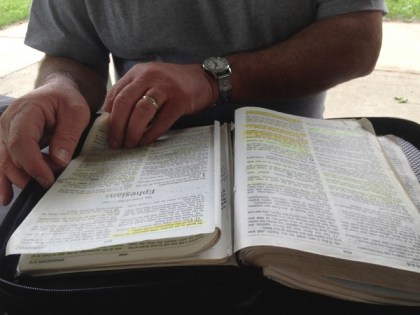
Our church met in a park last Sunday night, and I snapped the above photo of one our elder’s Bible before he spoke. You notice his Bible is marked and falling apart. It reminds me of the Charles Spurgeon quote: “A Bible that’s falling apart usually belongs to someone who isn’t.” A well-worn Bible is what you want to see in a church leader.

I still think he needs a new one, but he is going through the trauma that I have also experienced. I had a wide margin Bible that was beginning to fall apart after a decade of use. I knew the bookstore manager and asked him about the lifetime guarantee. He would gladly give me a new Bible if I turned in my old one. I couldn’t part with it, although I did move to a new one. You spend years with a Bible making notes in it. You have treasures in your margins that you don’t want to loose. Notes and underlining are a way of making the book your own.

I read a publishing statistic somewhere. A paperback Bible is expected to last one year of daily use. A hardback Bible is expected to last five years, and a leather bound Bible is expected to last 10 years of daily use. Leather is not to make the Bible into a religious relic. It is used because it makes for a durable binding. In fact, if you scan through any old libraries, you will find many leather bound books for that reason.

I have also seen pristine Bibles that shouldn’t have been. I once made a visit to home. The person had a Bible they wanted to show me. It was brought to me with obvious pride. It was still in the box with the white paper wrapped around it. It was like new. Inwardly, I was a bit horrified. I think I mumbled something about Bibles are to be used.

My Bible is now on my iPad. It is what I use on a daily basis. It won’t have the signs of a binding’s wear. But it still has signs of daily use: checked off Bible reading guides, highlighting, and notes.

Which is it for you? Does your Bible look new even thought it isn’t or do you too have a well-worn Bible?


Even the Plowboy Shall Know

January 31, 2014

I want you to mentally travel back in time to the 14th century AD. As we travel back in time, we notice that all of our English translations have disappeared. How’s your Greek, Hebrew, or Latin? Upon arrival in the 14th century, not only are there no English Bibles, but the religious leaders of the day regard allowing the “common man” to have a Bible to be a great danger. John Wycliffe produced an English translation in 1382 prior to the invention of the printing press. But the reaction to translating was so severe, that the Council of Constance in 1415 ordered Wycliffe’s remains to be disinterred and burned, and the ashes thrown on the River Swift.

In 1525, John Tyndale was the first to translate and produce a printed English New Testament. He was incensed by the prejudice of the religious clerics of his day. Foxe’s Book of Martyrs tells of Tyndale having a argument with one of these “learned” men:

Not long after, Tyndale happened to be in company of a certain divine, and in disputing with him he pressed him so hard that the doctor burst out into these blasphemous words: “We were better to be without God’s laws than the pope’s.”

Tyndale full of godly zeal, replied: “I defy the pope and all his laws;” and added, that if God spared him life, ere many years, he would cause a boy that driveth the plough to know more of the Scripture than he did.

Tyndale made good on this, but he had to leave England to do it because of opposition. And irony of ironies, the English Bible had to be smuggled into England in bales of cloth. Religious leaders burned copies of it, and Tyndale was later imprisoned and finally executed.

Your English Bible is a priceless possession. Not everyone has been so fortunate as to be able to read for themselves the Word of God. Regrettably, the dream that even the plowboy shall know scripture can be lost today, not for lack of a Bible, but for lack of a Bible reader.


Which Bible?

January 10, 2014

“Which Bible should I read?” The question is simple enough, but sometimes people ask the question with a subtext. The subtext goes something like this: there are so many different translations of the Bible, how does God expect me to sort this out? The subtext’s complaint then becomes an excuse for procrastination and inaction.

Informed Christians know that the Old Testament was written for the most part in Hebrew with a small portion in Aramaic, and the New Testament was written in Greek. That means when there are controversies over meaning, the final appeal must be to the original languages. Yet, that does not rule out the importance of translations.

Translating the Bible into various languages has been done since earliest times (for example with the New Testament into Syriac and old Latin), but it received a greater emphasis beginning in the Reformation. Most people are not going to be in the position to learn Greek and Hebrew, yet we have a great interest in knowing what God’s word says.

So what are some good guidelines for choosing a Bible translation?

  1. Choose a translation done by a committee. Committee members serve as checks and balances on one another to prevent a bias from entering the translation. Most major translation have been done by a committee, and most modern ones have had committees composed of a spectrum of Christian groups. That doesn’t mean never read a translation by an individual, and it doesn’t mean that bias can never be found in a committee translation. It rather reflects the safest place to start.
  2. Be informed about translation philosophy. There are two basic approaches to translations: formal equivalence (more word to word) and functional equivalence (more thought to thought). Most translations can be described as formal equivalent or functional equivalent. Most translations will describe their approach in the preface. Both approaches have their strengths and weaknesses. Comparing the two approaches can be valuable. It is important to know which approach you are reading. I find formal equivalence helpful for close study, but when I was a new reader of the Bible, I found the functional equivalence helpful to my fledgling understanding.
  3. You can read more than one and compare. Although most of us will choose a primary translation for reading and study, we live in a world where it is easy to compare translations. Computers and mobile devices make this especially true. I’ve learned a lot through the years comparing the two kinds of translation approaches and different translations. Sometimes differences in translations make no real difference in overall meaning. Sometimes differences reflect possible nuances in the original languages, and sometimes differences alert the reader to problems of interpretation. But having read many different translations of the Bible, my overall impression is that they are all translating the same book. We may find verses where one translation is preferable to another, but the overall, big picture message remains the same.

According to a recent listing from the Christian Booksellers Association, these are the top selling translations by units sold:

  1. New International Version
  2. King James Version
  3. English Standard Version
  4. New King James Version
  5. New Living Translation
  6. Holman Christian Standard Bible
  7. Reina Valera 1960 (if you read Spanish)
  8. New International Readers Version
  9. Common English Bible
  10. New American Standard Bible

Although I would have preferences in this list, the reality is that you could learn how to become a Christian and what you need to be saved from reading any translation on this bestseller list. Just read it!


Thank You Bible Teachers!

December 1, 2013

The truth is I can’t remember their names except for the ones when I was a teen. I can’t remember specific lessons, although fragments of classes and moments in classes do come to recollection. Somewhere along the line a class made a paper model of the tabernacle. Songs, crayons, rounded safety scissors, Elmer’s glue, and a lot of patience on the part of teachers were a part of the experience.

It was in these classes that my first knowledge of the Bible came. It was there I heard of Adam and Eve, Cain and Abel, Noah and the Flood, Abraham and Sarah, and all the other great narratives of the Bible. Flannel graph figures of Jesus and the Apostles brought to life the gospels. It was in these classes that a life long study of the Bible was born. It was in these classes that faith took root.

Bible teachers share their time and energy with students. It’s not just the time in class that teachers share. It takes time to be prepared. When you multiply 52 weeks times Sunday and Wednesday times the number of classes that we have, you realize the hundreds and even thousands of volunteer hours it takes for our Bible classes. And it is not just time, but energy too. Preparing a class and teaching a class is work, but it is rewarding work.

Bible teachers share their faith. Why bother to teach? Is it not because we believe in God and in the gospel of Jesus Christ? Our faith motivates us to share this message with others. The Bible lessons we teach are God’s message to a lost world. “So faith comes from hearing, and hearing through the word of Christ” (Romans 10:17 ESV). Even small children have the beginnings of faith. Elementary students have a great capacity to learn facts. When their ability to do abstract thinking develops around the age of 12, this great reservoir of facts is not lost, but is built upon. These basic facts can lead them to more mature understandings of God’s will. And most important of all, the students hearing the word also come to faith.

Bible teachers share their commitment. Teaching requires commitment. There is the commitment of time. There is commitment to be present at Bible studies and worship. There is the commitment to prepare and read your Bible. There is commitment to pray for your students and your class. Commitment is very important and attractive. Commitment begets commitment. Only the live ember spreads the fire.

To the Bible teachers in my life, I say thank you. To the Bible teachers of this church, I say thank you. What you share with others can influence for eternity.


One Bite at a Time

August 30, 2013

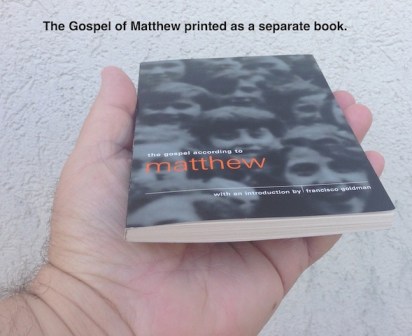
How do you eat an elephant? The old time management answer is: one bite at a time. Our printed Bibles may seem like a thousand page plus elephant. The reality is that the Bible is a library of books, none of which are very large. Most books of the Bible could be read in an evening. Individual books if printed separately would seem pamphlet sized. None would be as big as a best-selling, paperback novel.

Matthew as a separate book

The following chart is based on an audio version of the Bible. I realize reading times vary. Silent reading is usually faster than reading aloud, yet most of us probably stop and think about what we are reading. We may reread a section. We may be interrupted. All of this slows us down. Faster is not necessarily better. The following chart is simply a guideline. The chart is to encourage you to begin to take one bite at a time.

Bible books that can be read in 15 minutes or less.
Ruth, Song of Solomon, Joel, Obadiah, Jonah, Nahum, Habakkuk, Zephaniah, Haggai, Malachi, Philippians, Colossians, 1 Thessalonians, 2 Thessalonians, 1 Timothy, 2 Timothy, Titus, Philemon, James, 1 Peter, 2 Peter, 2 John, 3 John, and Jude.
Total 24 out of 66 books.

Bible books that can be read in 30 minutes or less.
Esther, Ecclesiastes, Lamentations, Amos, Micah, Galatians, Ephesians, and 1 John.
Total 8 books giving us a running total of 32 books out of 66.

Bible books that can be read in one hour or less.
Ezra, Nehemiah, Daniel, Hosea, Zechariah, Romans, 1 Corinthians, 2 Corinthians, and Hebrews.
Total of 9 books giving us a running total of 41 books out of 66.

Bible books that can be read in 1½ hours or less.
Joshua, Judges, and Revelation
Total 3 books giving us a running total of 44 books out of 66.

Bible books that can be read in 2 hours or less.
Leviticus, Deuteronomy, 1 Samuel, 2 Samuel, 1 Kings, Job, Proverbs, Matthew, Mark, John, and Acts.
Total of 11 books giving us a running total of 55 books out of 66.

Bible books that can be read in 2½ hours or less.
Exodus, Numbers, 2 Kings, 1 Chronicles, and Luke
Total 6 books giving us a running total of 61 books out of 66.

Bible books that can be read in 3½ hours or less.
Genesis, Isaiah, and Ezekiel
Total of 3 books giving us a running total of 64 books out of 66.

Bible book that can be read in 4 hours or less.
Jeremiah
Total of 1 book giving us a running total of 65 books out of 66.

Bible book that can be read in 4½ hours or less.
Psalms
Total of 1 book giving us a running total of 66 books.