“Pass It On”

June 27, 2014

The British and Foreign Bible Society has launched an initiative called “Pass It On” for 2014. The idea is to encourage adults to read the Bible to children or to tell them the stories of the Bible. This major push arose from a survey that was done of children between the ages of 8 to 15 and parents of children age 3 to 16 in the United Kingdom. Here is what they found.

In the Survey of 8 to 15 year olds in the U.K.

  • 23% had never read, seen or heard Noah’s Ark.
  • 25% had never read, seen or heard the Nativity.
  • 54% had never read, seen or heard Joseph and his coat of many colors.
  • 60% had never read, seen or heard the Feeding of the 5,000
  • 61% had never read, seen or heard the Good Samaritan
  • 63% had never read, seen or heard the Creation account.
  • 72% had never read, seen or heard Daniel and the lion’s den.
  • 85 % had never read, seen or heard the story of Solomon.

In the Survey of Parents of Children 3 to 16 in the U.K.

  • 30% did not recognize the story of Adam and Eve
  • 31% did not recognize the story of David and Goliath
  • 27% did not recognize the story of the Good Samaritan

Besides being tested on the plot lines of Bible stories, they were also given the plot lines of various stories outside the Bible to see if they thought they were in the Bible. Would the recognize that these stories are not found in the Bible? Here’s how it went with the parents.

  • 34% thought the plot line of Harry Potter was or might be in the Bible
  • 54% for the plot of the Hunger Games
  • 27% for the plot line of Superman
  • 46% for the plot line of The Da Vinci Code

Yes, this is a survey for Great Britain and not the United States. There is an obvious difference between the two countries. Currently, the U.K. has a church attendance rate at about 12% while the rate in the U.S. is at 43%. But it is a cautionary tale. What happens when one generation fails to pass on the Bible?

“We will not hide them from their children,
but tell to the coming generation
the glorious deeds of the LORD, and his might,
and the wonders that he has done. Psalms 78:4,ESV

Sources: “Church Attendance Statistics by Country
http://www.biblesociety.org.uk/about-bible-society/our-work/pass-it-on/


A Well-Worn Bible

June 20, 2014

A Well-Worn Bible

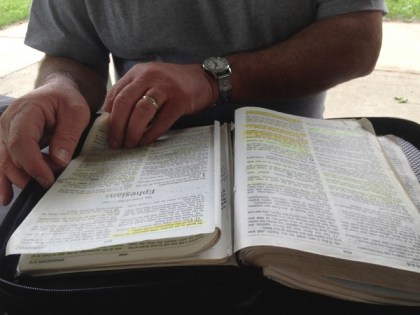
Our church met in a park last Sunday night, and I snapped the above photo of one our elder’s Bible before he spoke. You notice his Bible is marked and falling apart. It reminds me of the Charles Spurgeon quote: “A Bible that’s falling apart usually belongs to someone who isn’t.” A well-worn Bible is what you want to see in a church leader.

I still think he needs a new one, but he is going through the trauma that I have also experienced. I had a wide margin Bible that was beginning to fall apart after a decade of use. I knew the bookstore manager and asked him about the lifetime guarantee. He would gladly give me a new Bible if I turned in my old one. I couldn’t part with it, although I did move to a new one. You spend years with a Bible making notes in it. You have treasures in your margins that you don’t want to loose. Notes and underlining are a way of making the book your own.

I read a publishing statistic somewhere. A paperback Bible is expected to last one year of daily use. A hardback Bible is expected to last five years, and a leather bound Bible is expected to last 10 years of daily use. Leather is not to make the Bible into a religious relic. It is used because it makes for a durable binding. In fact, if you scan through any old libraries, you will find many leather bound books for that reason.

I have also seen pristine Bibles that shouldn’t have been. I once made a visit to home. The person had a Bible they wanted to show me. It was brought to me with obvious pride. It was still in the box with the white paper wrapped around it. It was like new. Inwardly, I was a bit horrified. I think I mumbled something about Bibles are to be used.

My Bible is now on my iPad. It is what I use on a daily basis. It won’t have the signs of a binding’s wear. But it still has signs of daily use: checked off Bible reading guides, highlighting, and notes.

Which is it for you? Does your Bible look new even thought it isn’t or do you too have a well-worn Bible?


Being There

June 13, 2014

Fatherhood! It is the most challenging and rewarding role that a man can have. I suspect that none of us ever feel adequate to the task. After all, it is on the job training, and we carry our own relationship with our fathers around with us with all of its help and its own set of inadequacies.

The story is told of a young preacher who had a sermon entitled “The Ten Commandments of Parenthood.” Of course, it was written before he became a father. As his children became older, the sermon was re-titled, “The Ten Principles of Parenthood.” The reality of rearing children made him a little less sure of himself. By the time his children became teenagers, the sermon was entitled “The Ten Suggestions That May or May Not Work.” The feeling of inadequacy may just be part of the territory.

Despite such feelings, I’m now the proud father of adult children. It is hard for me to believe. It is trite to say that time flies. When your kids are squabbling with one another in the backseat of the car, it’s hard to believe that this will ever pass by quickly. But it does. So what wisdom have I learned?

The world needs fathers – not just perfect fathers, if such a species exists. And one of the most important job qualifications is being there. Children need a lap to climb into for a story to be read. They need Dad to wrestle with them on the floor. They need to be tucked into bed. Someone needs to go to school conferences and programs, ball games and concerts. They need someone to take them to Bible class and worship. They need someone who is active in the life of the church, so that they will be too.

That is the rub, isn’t it? We must somehow balance job and activities with family time. I’ve had lots of evening meetings through the years, so I know how it can be. None of us are perfectly available. But we must communicate to our children that they are important by our presence. Our participation in their lives matters!

Being with our children is a vital part of communicating our values. Discipline and instruction occur with interaction from parents. One researcher found that feelings of closeness and high levels of time spent together are vital to sharing our values. They are three times more likely to reproduce our values in our children than parental emphasis on those values alone. We have to walk the walk with our children, and that takes being there.

That shouldn’t surprise us. It is the picture of parenthood in Deuteronomy 6.

And these words that I command you today shall be on your heart. You shall teach them diligently to your children, and shall talk of them when you sit in your house, and when you walk by the way, and when you lie down, and when you rise. Deuteronomy 6:6-7, ESV

Christian, spiritual children do not happen by accident. Our participation is vital. One of the most important things you can do as a Dad is being there.


The Fear of God

June 6, 2014

I was once caught in a dreadful thunderstorm. The storm was powerful. I saw so many lightning strikes around me that it felt like being caught in an artillery barrage. I felt fear, but it was more the fear that tends towards awe, because I felt safe. I was sheltered from the storm, but I also wasn’t going to run out into the storm with lightening rod in hand to challenge it. In some small way, it teaches me about the fear of God.

For many, the fear of God is a difficult subject to grasp, and yet it is inescapable in the Bible. God is even called “the Fear of Isaac” (Genesis 31:42). Fear is obviously a word with a range of meanings. On one end of the range are meanings like awe and reverence. At the other end of the range is terror and dread. Terror and dread are appropriate responses if our relationship with God is not right. But if our relationship with God is good, reverence and awe are still fitting. God even speaks of desiring people who “tremble at my words” (Isaiah 66:2).

My reverence and awe are fitting because God’s power, glory and majesty are so much beyond me. God is other, and I am his creation. Love for God can co-exist with such feelings, because God is good. He loves and keeps covenants. He is not capricious. God is not only an almighty creator, but a wondrous redeemer. But there are some lessons that the fear of God teaches that we must learn.

  • It leads to wisdom and understanding. “The fear of the LORD is the beginning of knowledge; fools despise wisdom and instruction.” (Proverbs 1:7 ESV) See also Proverbs 9:10.
  • It teaches us to avoid evil. “By steadfast love and faithfulness iniquity is atoned for, and by the fear of the LORD one turns away from evil.” (Proverbs 16:6 ESV)
  • It prolongs life and brings blessings. “The reward for humility and fear of the LORD is riches and honor and life.” (Proverbs 22:4 ESV) See also Proverbs 10:27, 14:27, 19:23.
  • It encourages growth in holiness. “Since we have these promises, beloved, let us cleanse ourselves from every defilement of body and spirit, bringing holiness to completion in the fear of God.” (2 Corinthians 7:1 ESV)
  • It is a motive for evangelism. “For we must all appear before the judgment seat of Christ, so that each one may receive what is due for what he has done in the body, whether good or evil. Therefore, knowing the fear of the Lord, we persuade others.” (2 Corinthians 5:10–11a ESV)
  • It leads to acceptable worship. “Therefore let us be grateful for receiving a kingdom that cannot be shaken, and thus let us offer to God acceptable worship, with reverence and awe, for our God is a consuming fire.” (Hebrews 12:28–29 ESV)
  • It is one of the conditions in which the church grows. “So the church throughout all Judea and Galilee and Samaria had peace and was being built up. And walking in the fear of the Lord and in the comfort of the Holy Spirit, it multiplied.” (Acts 9:31 ESV)

Not a Tame Lion

May 30, 2014

Aslan is the lion in The Lion, the Witch and the Wardrobe – the central figure of the Narnia Chronicles. The name comes from the Turkish word meaning “lion.” C.S. Lewis was straightforward in claiming that this character is “a divine figure.” Aslan is a symbol of Jesus Christ.

Why choose a lion? In the great heavenly throne vision of Revelation 5, Jesus is identified as “the Lion of the tribe of Judah, the Root of David” (Revelation 5:5). The lion was the symbol of the tribe of Judah (Genesis 49:9). Strength and conquest are in the imagery of the lion.

One instructive scene in The Lion, the Witch, and the Wardrobe is the conversation of Susan, Lucy, and Mrs. Beaver about Aslan. When Susan finds out that Aslan is the great Lion, she asks, “Is he – quite safe?” She’s afraid of being nervous when meeting him. Mrs. Beaver is not reassuring:

That you will, dearie, and no mistake … if there’s anyone who can appear before Aslan without their knees knocking, they’re either braver than most or just silly.

Lucy then asks a follow-up question: “Then he isn’t safe?” Mrs. Beaver has a great reply:

’Course he isn’t safe. But he’s good. He’s the King I tell you.1

Lewis is illustrating the awe we should feel towards God and Christ. It’s a healthy reminder that they are in charge not us. God is the One who wields omnipotence and carries out His purposes. It’s a reminder that those who have had visions of the unseen were awestruck. Isaiah was keenly aware of his sinfulness and cried out “Woe is me.” The Apostle John “fell at his feet as though dead” when he saw the vision of Christ (Revelation 1:17).

Yet, the goodness is also present with the awesomeness. Isaiah received forgiveness, but he also received a new mission in life. John received the reassurance that Christ had conquered death. Great is God’s mercy. But the goodness is not necessarily safe, if we are thinking in terms of our own comfort. God is demanding. There is a cost to discipleship. An encounter with God should change us.

Underlying both passages is the great battle between good and evil. Isaiah’s message was repent or judgment would come. John must reassure Christians to “be faithful unto death” as they lived in a hostile environment. God is merciful, but to be outside that mercy is anything but safe.

Lewis was right. Trust in His goodness but approach with awe. He’s not a tame lion.

____________________

1C.S. Lewis, The Lion, the Witch and the Wardrobe, p 86.


Spread Your Wings and Fly!

May 23, 2014

A bird built a nest near our house. We often disturbed the mother bird, and she would squawk and fly away. But we knew that this would be fleeting. In a matter of weeks, the baby birds would spread their wings and fly away. Children take longer to leave the nest, yet eighteen years fly by us so quickly. There are times when years seem like weeks.

I don’t know whether birds have fears, hopes, pride, regrets as baby birds take wing, but humans do. Time marches by relentlessly. The pressures of work and paying the bills take their toll on every parent, even when we value family. Regrets of things you didn’t do occur even when there is a storehouse of good memories, because you know things will never be the way they were when they spread their wings and fly.

Parents are like the scaffolding around a building during construction. The scaffolding is the external brace during the instability of the construction phase. But it’s not intended as a permanent part of the plans.

When the external brace is removed, what will happen? Your parents won’t necessarily be around to get you up for class, work or church. You will decide your level of involvement in the church. You will decide more than ever before who your friends will be and who you will date. Faith is not inherited (Matthew 3:7-10). You will not spiritually survive on your parents’ faith. This will be a critical time for you. You must move beyond “what you believe” to “why you believe.” Your decisions will decide your direction. We must “commit you to God and to the word of his grace, which can build you up and give you an inheritance among all those who are sanctified” (Acts 20:32, NIV).

Graduation is also an exciting time in your life—a time of transition. The end of Ecclesiastes has words for the young.

Follow the ways of your heart and whatever your eyes see, but know that for all these things God will bring you to judgment. (Ecclesiastes 11:9b, NIV)

Certainly, Ecclesiastes is not encouraging an unrestrained following of the heart. The admonition occurs within the context of following God’s morality because of His judgment. But this piece of wisdom recognizes it is when we are young that all of life is before you. Within the context of following God, the encouragement is to follow your heart—to follow your dreams. Congratulations on your graduation. Spread your wings and fly!


The Habit of Thanksgiving

May 16, 2014

N.T. Wright in his mammoth work on Paul notes the practice of thanksgiving in Christian living. He writes:

Thanksgiving isn’t just a way of being a bit less grumpy and a bit more cheerful. It is a habit of the heart which indicates the nature and particular shape of the worldview. It is closely associated with joy, which for Paul is one of the primary signs of the spirit’s
work.1

What kind of a worldview elicits this thanksgiving? It is the view that God is the creator of the universe. Because there is a creator, there is someone to thank.

Wright cites a wonderful quote from the rabbis on giving thanks to God.

On comets, and on earthquakes, and on lightning and on thunder, and on storms say, “Blessed [be He] whose strength and might fill the world.” On mountains, and on hills, and on seas, and on rivers, and on deserts say, “Blessed [is He] who makes the works of the beginning.” R’ Yehuda says, “One who sees the great sea says, ‘Blessed [is He] who made the great sea,’ only if he sees it occasionally.” On rain and on good news say, “Blessed is He who is good and does good.” And on bad news say, “Blessed [are You] the true judge.”2

When we turn to the Bible, some form of the word thank, thanks, or thanksgiving occurs 170 times. Thanksgiving peaks in the Psalms for the Old Testament, and it peaks in the New Testament in the letters of Paul (the high point in Paul is in 1 Corinthians). Looking at these many occasions of thanks instructs us on how to be thankful.

The wisdom of learning to be thankful is important. The nineteenth century hymn lyrics by Johnson Oatman, Jr. pictures learning to be thankful even in times of discouragement. Because God is our creator there is always something that the Lord has done for which we can be grateful.

When upon life’s billows you are tempest-tossed,
When you are discouraged, thinking all is lost,
Count your many blessings, name them one by one,
And it will surprise you what the Lord hath done.

“A bit less grumpy and a bit more cheerful” is good way to be when it is deeply rooted in the view that God is my creator. It is not just a doctrine to add to the check list, but a practice to live. It is a habit of the heart, the habit of thanksgiving.

____________________

1Paul and the Faithfulness of God, p. 412.
2Mishnah Berakhot 9:2


Praise and Thanks to Mothers

May 9, 2014

Anna Jarvis worked for a national Mother’s Day by starting a letter-writing campaign. Jarvis’s own mother had expressed a hope that a day to commemorate mothers would be established. Two years after her mother had died, Jarvis began her campaign. In 1914, Congress passed the legislation designating the second Sunday in May as Mother’s Day. Many other countries have a special day for mothers although the date varies from country to country.

Giving thanks and praise to mothers has biblical roots. Proverbs contains the beautiful poem on the excellent woman (31:10-31). The poem depicts a grateful husband and children praising this excellent woman:

Her children rise up and call her blessed;
her husband also, and he praises her:

“Many women have done excellently,
but you surpass them all.”

Charm is deceitful, and beauty is vain,
but a woman who fears the LORD is to be praised.

Give her of the fruit of her hands,
and let her works praise her in the gates.” (Proverbs 31:28–31, ESV)

Recently, someone drew my attention to Orations XVIII written in A.D. 374 by Gregory Nazianzus. The speech is for the funeral of Gregory’s father, but he praises his mother because she preceded his father in the faith and influenced him to the faith. He wrote:

She is a woman who while others have been honoured and extolled for natural and artificial beauty, has acknowledged but one kind of beauty, that of the soul, and the preservation, or the restoration as far as possible, of the Divine image…. The only genuine form of noble birth she recognized is piety, and the knowledge of whence we are sprung and whither we are tending…. To as great a degree has she, by her care and skill, secured the prosperity of her household, according to the injunctions and laws of Solomon as to the valiant woman, as if she had had no knowledge of piety; and she applied herself to God and Divine things as closely as if absolutely released from household cares, allowing neither branch of her duty to interfere with the other, but rather making each of them support the other.

Fitting on any day, but especially on Mother’s Day, is praise and thanks to mothers.


Angels Long to Look

May 2, 2014

Elizabeth was on her way to coffee in her Upper West Side neighborhood in New York City. She spotted it among the garbage bags set out for the morning collection. It was a canvas with red, purple, yellow, and grey. She walked past it at first.

But she would later tell that she just felt that she had to go back. It was a huge, powerful and beautiful painting. She believed it was wrong for it to be in the garbage, so she rescued it.

She hung the painting in her home. She appreciated it; it was not trash to her. But she was also curious. She did research on the Internet which led her to the truth. The painting was “Tres Personajes” by Mexican artist, Rufino Tamayo. It was a masterpiece stolen from a storage warehouse about decade and a half prior to Elizabeth finding it in the trash. Elizabeth returned the painting and was rewarded. The painting was expected to sell for a million dollars.

To someone it was trash. To Elizabeth it was a beautiful painting to hang on the wall. To the art experts at Southeby’s it was a very valuable piece of art. Sometimes it helps us to see something through another’s eyes. I suspect that is part of what Peter is doing in the following passage.

Concerning this salvation, the prophets who prophesied about the grace that was to be yours searched and inquired carefully, inquiring what person or time the Spirit of Christ in them was indicating when he predicted the sufferings of Christ and the subsequent glories. It was revealed to them that they were serving not themselves but you, in the things that have now been announced to you through those who preached the good news to you by the Holy Spirit sent from heaven, things into which angels long to look. (1 Peter 1:10–12 ESV)

The prophets searched and carefully inquired. They knew that what lay ahead was valuable, but it was not for their generation. Christ’s sufferings and subsequent glories are for those of us on this side of the cross. But will we value this salvation? Will we set this treasure out with the trash, or will we recognize its profound worth and risk everything to have it? Prophets wanted what we now have. Will we share this salvation with the world that desperately needs it?

Sometimes we become discouraged when someone treats this treasure as trash. Peter reminds us of its value through the eyes of others. Salvation is so precious that even angels long to look.


Free at Last, Free at Last

April 25, 2014

We live in the land of the free. The Bill of Rights guarantees to us certain liberties. We have freedom of religion, freedom of speech, freedom of the press, and the right to peaceful assembly. Our freedoms have made our country “the land of opportunity.”

Yet it’s a paradox. Freedom occurs in the context of rules and responsibilities. Freedom in our country doesn’t mean I can do just anything I please. An easy way to reflect on this is to consider the rules of the road. I have great freedom to travel by automobile. The rules of the road are in some sense restrictive, but viewed from another angle they are liberating. Imagine if no one obeyed the rules of the road. It would be anarchy. Suppose that no one stopped at stop lights or stop signs or driving on the right or left side of the road were a matter of whim. The flow of traffic would be impeded. “Freedom” from these rules would actually give us less true freedom.

Consider the words of Jesus – “and the truth will set you free.” It is easy for these words to be ripped out of their context. I’ve seen them engraved on buildings in universities, where the idea was probably that learning and the pursuit of truth is liberating. I’ve heard it used in pop psychology kinds of settings: “If I just tell my irritating roommate that I’m fed up and I’m going to move out, admitting this truth makes me feel free.”

But notice what Jesus actually said: “If you abide in my word, you are truly my disciples, and you will know the truth, and the truth will set you free” (John 8:31-32, ESV). The freedom that Jesus is promising occurs in the context of obedience to his teachings.

I can imagine someone complaining, “I don’t like being told what to do.” Yet another one of those interesting paradoxes emerges. “Doing our own thing” often leads to self-destructive and addictive behaviors. We enslave ourselves.

When Jesus promises freedom, it is the freedom to be human as God intended us to be. Jesus seeks to transform us as we slough off the old person of sin. And strangely in God’s intent, there is true freedom, although human hearts frequently rebel against it.

In the words of the old spiritual, freedom is having a King and meeting Him someday.

Some of these mornings, bright and fair
I thank God I’m free at last
Goin’ meet King Jesus in the air
I thank God I’m free at last

Free at last, free at last
I thank God I’m free at last