What We Learned from Jerry

October 4, 2013

Jerry Tallman has conducted thousands of evangelistic Bible studies through the years. He shared what he has learned with us in his workshop. What have we learned form Jerry?

Despite having conducted thousands of Bible studies, Jerry has never converted anyone. It is the gospel that is the power of God for salvation (Romans 1:16). The power to convert is in the message not the messenger.

We often worry about being rejected or messing up, but if the person is lost (separated from God because of sin), their situation is not going to be worse because we have attempted to share the good news. The person who is lost is in danger of being eternally lost unless he or she is rescued by the good news.

Jerry asked each night whether we had learned anything new, and the answer each night was no. What he talked about were things that we already knew. Our problem is not needing to know more, but to actually use what we already know.

All of us should be able to tell someone what God has done for us.

When Jesus talked with the Samaritan woman at the well, he turned a conversation about physical things into a conversation about spiritual things. We need to think of ways of introducing the spiritual into our conversations as well. It may be in simply offering to pray for someone’s needs.

People need to see us as good news. It may be in service. It may be in the quality of our life seen as being different from the world. As Edgar Guest’s poem says, “I’d rather see a sermon than hear one any day.” Seeing us as good news may be the preparation for them to hear the good news.

We don’t have to have all the answers. It is fair to say, “That’s a good question, let me write that one down.” Questions can then become studies. You can research what the Bible says and get back to the person for a further study.

Studying with a person is letting them read what the Bible has to say for themselves. It is not us telling them what we think. We just help them to find the passages. If they object to what the Bible says, then their argument is with God not us.

We need to meet the lost, reach them, and keep them. We all need to think of ways of meeting the people in our lives and getting them to think about spiritual things. Not all of us will be the ones to reach them, that is, actually do a one-on-one study with them. But we all have a part in meeting people and introducing the gospel to them and being the bridge between them and people who can study with them. We also need to keep them. The whole body of Christ plays a part in maturing the new Christian. All of us have things that we can do to make this an evangelistic church.

Jerry reminded us that spiritual swords are sharpened to be used.


Who Are Deacons and What Do They Do?

September 20, 2013

“Deacon” is not a translation but a transliteration. A transliteration is when you spell a word of one language in the corresponding letters or characters of another language. The Greek word is “diakonos” (Strong’s number G1249). It is usually translated as servant or minister. The definition in the standard Greek dictionary of the New Testament is: (1) one who serves as an intermediary in a transaction, agent, intermediary, courier, and (2) one who gets something done, at the behest of a superior, assistant.1 A number of groups and individuals are called “diakonos” in the New Testament.

  • Servants of a king: Matt. 22:13
  • Servants at a wedding: John 2:5, 9
  • Governmental rulers: Romans 13:4 (2x)
  • Christ: Romans 15:8, Galatians 2:17
  • Satan’s servants: 2 Corinthians 11:14-15
  • A number of individuals: Paul and Apollos (1 Cor. 3:5), Paul (Eph. 3:6-7, Col. 1:23, 25), Timothy (1 Tim. 4:6), Phoebe (Rom. 16:1), Tychicus (Eph. 6:21, Col. 4:7), and Epaphras (Col. 1:17).
  • Disciples: Matt. 20:25, 23:11, Mark 9:35, 10:43, John 12:26, 2 Cor. 3:6, 11:23.
  • Deacons: Phil. 1:1, 1 Tim. 3:8, 3:10 (verb form), 3:12

It is not unusual for words to have a general use and a technical term use. There is a proper sense that all Christians are servants. Yet, it is also clear that there is a special group of servants in Philippians 1 who are distinguished from the other church members (i.e., the saints) and the overseers. The fact that we have qualifications in 1 Timothy 3:8-13 also indicates a specially appointed group of servants. Not everyone has the qualifications mentioned in this text.

But what do deacons do? The New Testament doesn’t give specifics. The word itself suggests that deacons assist the work of the overseers in some way. They are said to serve (diakoneō, G1247) in 1 Timothy 3:10. Acts 6:1-6 may at least be a case of proto-deacons. The men in this passage are not called deacons. Years later Philip is referred to as “one of the seven” (Acts 21:8). Yet the passage speaks of the “daily ministry” (diakonia, G1248) in Acts 6:1, and the apostles do not want to neglect the preaching of the word of God “to serve tables” (diakoneō, G1247) in Acts 6:2. Certainly to serve tables could refer to serving food at a table, but it could also mean “serve as accountants.”2 The word table is associated with money changers and banking in the ancient world and therefore accounting. Even our English word “bank” comes from the “bench” of the money lender. The seven of this passage are either distributing food or funds.3 At any rate, the seven assisted and served in the work of the church so that the Apostles did not lose the focus of their ministry. It would seem that deacons function in the same way in relationship to overseers.

_____________________

1A Greek-English Lexicon of the New Testament and Other Earl Christian Literature (abbreviated as BDAG), p. 230

2BDAG, s.v. trapeza, p. 1013

3Several English translations say in Acts 6:1 “daily distribution of food.” However, the Greek text only has “daily ministry” or “daily service” (cf. the KJV or ASV). I think it is an open question as to whether the Seven were distributing food or money. The bottom line was that they were taking care of widows.


The Work of Elders

September 13, 2013

We tend to use the word “elders” in referring to our congregation’s leaders. This term (presbuteros in Greek) was used in both Jewish and Gentile environments for religious and civic leaders in the ancient world. Jack P. Lewis notes, “The term ‘elder’ suggests a leadership built on respect and reverence (cf. Lev. 19:32), a reverence that recognizes ability, service, knowledge, example, and seniority.”1

The New Testament uses “elders” interchangeably with two other words: overseer (episkopos) and shepherd (poimēn). Bishop is another word used in English for overseer. Unfortunately, it now has some historical baggage and has come to mean something different from its New Testament usage. Pastor comes into English from Latin and is simply a word meaning shepherd. The nouns “overseer” and “shepherd” also have corresponding verbs that are used in leadership contexts: to overseer (episkopeo) and to shepherd (poimainō).2 The following New Testament passages confirm the idea that these words were used interchangeably to refer to the same group of leaders within the congregation: Acts 20:17, 28, Titus 1:5-7, and 1 Peter 5:1-2.

Oversight. So what do elders do? Both the words “overseers” and “elders” suggest oversight, leadership, and decision making. In 1Timothy 5:17, Paul notes elders “who rule well” (ESV). The Greek verb in this verse (proistēmi) can be defined as “to exercise a position of leadership, rule, direct, be at the head (of).”3 The same verb is used in 1 Timothy 3:5 to speak of a elders’s leadership in his family.

Teaching. One of the qualifications of overseers in 1 Timothy 3 is “able to teach” (3:2). Some may “especially” give attention to “preaching and teaching” (1 Timothy 5:17). “Especially” lets us know that the work goes beyond these things, but may include them. In the qualifications given in Titus, there is the need “to give instruction” (Titus 1:9). And shepherds are linked with others in Ephesians 4:11 as equipping the saints for service.

Guarding. The word “overseers” includes the idea of guardians. The image of shepherds also includes the thought of guardians of a flock of sheep. Paul warns the Ephesian elders of dangers coming to the church and urges them to “pay careful attention to yourselves and to all the flock” and “be alert” (Acts 20:28, 31).

Shepherding. Shepherd is a very personal image. The figure of speech evokes the role of shepherd with his sheep: feeding, protecting, caring for wounds, and searching for the lost sheep.

And finally, we note that elders are “examples to the flock,” the church (1 Peter 5:3).

____________________

1Lewis, Leadership Questions, p. 21

2I’ve given the first person singular form rather than the infinitive, because it is the dictionary form.

3BDAG, p. 870


Learning from the Names of God

September 6, 2013

In a recent reading of Genesis, one of the things that struck me is how we come to know God from the narrative. Names for God are introduced in the context of a story. God’s actions and speeches are a part of a narrative. This is a striking contrast to how we might learn about God in other contexts. The systematic theology will discuss God in abstract definitions. Historically, the catechism will teach about God with the repetition of certain questions and answers. The way that God has chosen to introduce himself is strikingly more personal and more interesting. The sharing of life stories is typically the way we get to know one another. Who doesn’t delight in a story?

Elmer Towns in his book, My Father’s Names, gives an appendix listing 85 names of God in the Old Testament. Primary names are God, Jehovah, and Lord. God (Elohim, El, and Eloah) suggests the mighty creator (Gen. 1:1). Jehovah (or Yahweh) is explained by “I am”—the self-existing one who is faithful to His covenants (see Exodus 3:14-15). Lord or Master (Adonai) reminds us who is in control and to whom do we belong. The remaining names in Town’s list are compound names containing either “God” or “Jehovah” with a further description.

Studying the names of God is one way of getting to know God. Elmer Towns suggests several benefits from such a study. The names of God reveal different attributes of God. We gain insights into God’s character from the names and descriptive titles found in scripture. Secondly, the names suggest the kind of relationships we can have with God. When we hear God called Shepherd and Rock (Genesis 49:24), we are finding out about another’s relationship with God, and it suggests the kind of relationship we too may find. Third, the names of God often reveal that God is the source to meet our needs and solve our problems. As we grasp the meaning of God’s names, we may learn to be dependent upon Him.

Eighty-fives names are beyond what I want to list here, but consider the following list from Genesis.

  • Jehovah, God Most High (Genesis 14:22)
  • My Lord Jehovah (Genesis 15:2)
  • The God who sees (Genesis 16:13)
  • God Almighty (Genesis 17:1, 2) also Mighty One of Jacob (Genesis 49:24)
  • Jehovah-jireh that is Jehovah will provide (Genesis 22:14)
  • The Shepherd, the Rock of Israel (Genesis 49:24)

May our knowledge of God (both intellectual and experiential) grow as we learn from the names of God.


One Bite at a Time

August 30, 2013

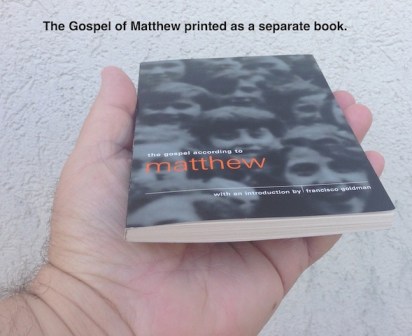
How do you eat an elephant? The old time management answer is: one bite at a time. Our printed Bibles may seem like a thousand page plus elephant. The reality is that the Bible is a library of books, none of which are very large. Most books of the Bible could be read in an evening. Individual books if printed separately would seem pamphlet sized. None would be as big as a best-selling, paperback novel.

Matthew as a separate book

The following chart is based on an audio version of the Bible. I realize reading times vary. Silent reading is usually faster than reading aloud, yet most of us probably stop and think about what we are reading. We may reread a section. We may be interrupted. All of this slows us down. Faster is not necessarily better. The following chart is simply a guideline. The chart is to encourage you to begin to take one bite at a time.

Bible books that can be read in 15 minutes or less.
Ruth, Song of Solomon, Joel, Obadiah, Jonah, Nahum, Habakkuk, Zephaniah, Haggai, Malachi, Philippians, Colossians, 1 Thessalonians, 2 Thessalonians, 1 Timothy, 2 Timothy, Titus, Philemon, James, 1 Peter, 2 Peter, 2 John, 3 John, and Jude.
Total 24 out of 66 books.

Bible books that can be read in 30 minutes or less.
Esther, Ecclesiastes, Lamentations, Amos, Micah, Galatians, Ephesians, and 1 John.
Total 8 books giving us a running total of 32 books out of 66.

Bible books that can be read in one hour or less.
Ezra, Nehemiah, Daniel, Hosea, Zechariah, Romans, 1 Corinthians, 2 Corinthians, and Hebrews.
Total of 9 books giving us a running total of 41 books out of 66.

Bible books that can be read in 1½ hours or less.
Joshua, Judges, and Revelation
Total 3 books giving us a running total of 44 books out of 66.

Bible books that can be read in 2 hours or less.
Leviticus, Deuteronomy, 1 Samuel, 2 Samuel, 1 Kings, Job, Proverbs, Matthew, Mark, John, and Acts.
Total of 11 books giving us a running total of 55 books out of 66.

Bible books that can be read in 2½ hours or less.
Exodus, Numbers, 2 Kings, 1 Chronicles, and Luke
Total 6 books giving us a running total of 61 books out of 66.

Bible books that can be read in 3½ hours or less.
Genesis, Isaiah, and Ezekiel
Total of 3 books giving us a running total of 64 books out of 66.

Bible book that can be read in 4 hours or less.
Jeremiah
Total of 1 book giving us a running total of 65 books out of 66.

Bible book that can be read in 4½ hours or less.
Psalms
Total of 1 book giving us a running total of 66 books.


When the Flower Withers

August 23, 2013

The statistics indicate a moral change in our society that many of us have witnessed during our lifetime. The violent crime rate in the US was 160.9 per 100,000 population in 1960. In 2011, it was 386.3 per 100,000. The divorce rate in 1960 was 2.2 per 1,000 population. It reached its high point in 1981 with 5.3 per 1,000 and in 2009 was 3.5 per 1,000. If the divorce rate has dropped since the 1980s, cohabitation (“living together”) has increased. In 1960, there were 439,000 cohabiting couples. In 2005, 4.85 million cohabiting couples were reported by the Census Bureau — up more than 10 times the rate in 1960. In 1960, out of wedlock births were 5.3% of the total births. In 2007, they were 40% of the total births.

Elton Trueblood in his 1969 book, A Place to Stand, made an important observation on the moral decline of Western culture:

Always men have broken laws; that is nothing new. What is new is the acceptance of a creed to the effect that there really is not objective truth about what human conduct ought to be. The new position is not merely that the old laws do not apply, but rather that any moral law is limited to subjective reference. While this has been the position of a few individuals in various generations of the past, our time differs in that this has suddenly become the position of millions. Some of them still have a slight connection with the Judeo-Christian heritage, but the obvious conflict in convictions will, if it continues, finally dissolve even the mild connection that still appears to exist. If there is no objective right, then there is not even the possibility of error, and intellectual and moral confusion are bound to ensue.1

Trueblood calls ours “a cult-flower civilization.” His analogy means that when people first began to cut themselves off from Judeo-Christian ethics, they initially behaved in moral ways. Like the cut-flower exhibiting life though cut off from its roots. Such life though eventually withers, and in the same way, cut from the roots of Judeo-Christian ethics, our society undergoes a moral decline.

So what does this mean for Christians and the church today? It is easy to be a bit depressed, and certainly the cultural shift is lamentable. But it does not change our mission to share the good news. In fact it means that the difference between the lifestyle of a truly, biblical Christian is going to be even more distinct from the world around us. We face a culture much more like the one that Peter and Paul faced. They saw opportunity. The good news went out into that kind of world and turned the world upside down. When the flower withers, the good news is needed all the more.

____________________

1Elton Trueblood, A Place to Stand, p. 15.


Forces of Modernity

August 16, 2013

James W. Sire in his book, Chris Chrisman Goes to College, examines the forces of modernity that affect our Christian faith. He does it my mixing commentary with a novel about fictional Chris Chrisman going to a state college, and the challenges to his faith that he faces there. But these forces of modernity affect all of us and not just college students.

Individualism. Individualism has roots in Christian faith. After all, we believe that individuals are created in the image of God and are unique and valuable. We believe that salvation is an individual matter. Modern individualism however goes to some extremes. It desires to be totally autonomous from God. It believes that the individual is self-sufficient and can define himself anyway he wants.

Pluralism. Pluralism can be defined in several ways. On one level, it is simply the getting along of many religious, ethnic and cultural beliefs in one society. No one can argue with the need to coexist with our differences. But pluralism is also used with a philosophical meaning maintaining that no one explanation for life is true. In a situation where many religions exist, the influence of pluralism is to see all of them as viable. To raise the question whether one of them is true is to violate social mores.

Relativism. Faced with pluralism, relativism refuses to question the truth of any philosophical or religious position. The response is: “It’s true for you, but it’s not true for me.” Ethical values are treated in the same way. Everything is subjective and relative.

Privatization. Privatization is the tendency to split social reality into two sectors: public and private. The public sector has to do with government, politics, business, economics, production, technology, and science. The private sector involves religion, morality, leisure, and consumption. The tendency in our culture is to want to keep these two sectors separate.

The danger to a college student or anyone else is that if we obey the forces of modernity our faith dies. Christianity demands to be defended as true in opposition to other views. Granted that this defense should be made with gentleness and respect (see 1 Peter 3:15-16), but it should still be made. Christianity demands our whole life, both public and private. The forces of modernity give us a choice: (1) the erosion of our faith or (2) choosing to be out of step with the times.


The Titanic

August 9, 2013

April 14, 1912—a night to remember, the night the Titanic sank in the cold waters of the North Atlantic. As James Cameron’s movie has proved, the story of the Titanic still captures our imagination. Recently, my family visited the Titanic exhibit. Artifacts from the shipwreck were on display. Each of us received a boarding pass as we entered the exhibit. Mine was of course male, which didn’t give my person very good odds of survival even though he was a first class passenger. At the end of the exhibit, I was able to check the list of lost and survivors. The man with my boarding pass had died that fateful night. The impression of the exhibit is sobering.

It also brought reflections at the time of the tragedy as well. R. H. Boll was editor of the Gospel Advocate in 1912. Eleven days after the tragedy, in the April 25th issue, Boll reflected on the Titanic:

A catastrophe like this should not pass over the minds of the people of God without making its deep impression. It is, as it were, a miniature reproduction, and, like the destruction of the cities of the plain, a type forewarning and foreshadowing the goal of the world. Just as the Titanic sank, just so shall pass away the world and the lust thereof. So unexpectedly; so utterly beyond the reach of help; so irretrievably, shall it all perish, with its pomp and its glitter, its social distinctions, its pride, its folly, its wealth, its sins; and so shall it all be swallowed up in ruin.

“Salvation” was a great word that night on the Titanic. They may never have known the significance of it before. But they learned the meaning and the value of it that night in at least its temporal aspect; and possibly in its eternal import also. Most of them too late. Yet there was a remnant that escaped.

And was it not a privilege to each one of those that were called and permitted to enter the lifeboats, even if they did have to leave their things behind, and perhaps some friends and loved ones; even if they did have to endure discomfort and exposure on the small boats? But there are the many to-day, Christians, too, who “mind earthly things;” who count the salvations of God too difficult and inconvenient; who cleave to the world, and shall therefore be engulfed with it in its ruin and condemnation. “He that findeth his life shall lose it; and he that loseth his life for my sake shall find it.”

Finally, if you or I had been before enlightened of God as to the fate that awaited the Titanic on this voyage, we should have felt bound by every consideration of honor and regard for human beings to warn them each and all; and we would have endured their skepticism, their jeers and ridiculing and scorn, insults even, if by any means we might dissuade some from the ill-fated ship. But God has told us what shall come and must come to the world and how “the end of all things is at hand.” If you know the Savior, if you know the Way of escape, will you not for His sake and for the sake of the perishing souls go tell it to-day?1

Today, high-tech explorers bring us artifacts from the sunken Titanic, and movie special effects vividly portray that fateful night. May these reflections from 1912 give us some additional spiritual insights from the tragedy of the Titanic.

1Gospel Advocate 54/17 (25 April 1912): 513-14


The Frustrations of Bible Reading

August 2, 2013

The average American household has four Bibles or more. We are a long way from the times before the invention of the printing press when Bibles were expensive and rare. But having access to a Bible doesn’t necessarily mean Americans are Bible readers. A recent press release from Logos Bible Software provides these statistics about Bible reading among church attenders.1

  • 18–34% Rarely or never read the Bible
  • 12% Felt confused the last time they read the Bible
  • 11% Felt overwhelmed
  • 40% Felt an “unfavorable emotion”

Survey respondents also indicated their top frustrations with Bible reading.

  • 32% “I never have enough time”
  • 12% “The language is difficult to relate to”
  • 11% “I don’t feel excited about reading it”

Is reading the Bible frustrating? The answer is yes — at least initially. Everyone who develops the habit of regular Bible reading struggles to find time to read. It becomes easier, but I still go through busy times in my life when I play catch up on my reading guide. We also need to keep things in perspective. None of the books of the Bible are very long. Most are pamphlet size if they were printed by themselves. Each of the gospels could be read aloud in about two hours. In comparison, one of the most recent John Grisham novels would take nearly 13 hours read aloud — the entire New Testament could be done in about 16 hours.

I think most new Bible readers do feel confused and struggle to understand. I liken my first time reading through the Bible with fishing with a net with holes six inches wide. You can catch a big fish with it — some of the big ideas in the text, but many things will pass right through. Fishing with such a net would obviously be frustrating. Each time through the Bible your net becomes finer, and you “catch” more of what is in the text.

I suspect that talking about the frustration of Bible reading seems a bit sacrilegious. After all, the Bible is God’s word. How can we complain about God’s word? Yet, I know of few things in life that don’t entail a learning curve especially if they are worth doing. Admitting our frustrations is the first step in moving beyond them. Knowing that others have felt the same way in their journey can help us work through our own frustrations. Believe me when I say the journey is worth it.

1http://www.logos.com/press/releases/free-esv-bible. Note that the press release is about a free ESV Bible for iOS, Android, or Kindle Fire mobile devices. The free offer is good through August 10th. Use the press release link to find the offer. Logos is one of the Bible apps that I personally use on my iPad, and free is hard to beat.


The Ghost in the Machine

July 26, 2013

The problem with materialism as a world view is that it reduces what it means to be human. If we are no more than a biological machine, can we trust our thoughts? Are our actions a matter of free will? Some evolutionary biologists have in fact embraced determinism. Is there a self that goes beyond the programming of the electrochemical impulses of our bodies?

Reductionism is a fine intellectual game to play, but it is very difficult to live consistently. An episode of the British crime show, Inspector Lewis, illustrates the tension. Detective Inspector Robbie Lewis is the no-nonsense policeman. His partner is Detective Sergeant James Hathaway. Hathaway is the intellectual who provides the show’s dialogue with the needed literary or classical music reference. Before becoming a detective. he had been a theology student at Cambridge. In the episode, “Fearful Symmetry,” there are two exchanges that I found intriguing.

A young Oxford student has been killed, and the detectives must visit the lab of Dr. Ezrin, a biologist.

Hathaway: What do you actually study here, Dr. Ezrin?

Dr. Ezrin:The parts of the brain relating to learning. – how data is imprinted and stored in the memory. Anything you’ve ever felt is down to microscopic variation in the electrochemical balance in here (pointing to his brain). Everything we are – love, hate, anger, jealousy, desire…

Hathaway: And the soul?

Dr. Ezrin: Sorry, there is no ghost in the machine. When the machine stops, we stop.

Later the detectives learn that after an affair Dr. Ezrin has been stalking a woman who has a connection to their murder case. He has even broken into her apartment.

Lewis: You’re aware, Dr. Ezrin, that stalking is an offense?

Dr. Ezrin: I’m not a stalker. Look I went to her place once or twice … just as a… I don’t know. I was jealous.

Hathaway: Those electrochemical impulses can be a nuisance.

Hathaway’s quip accents the problem of reductionism. None of us explain our behavior away by saying my electrochemical impulses made me do it. Especially when we are in the wrong, we give reasons why in this case, our behavior is allowable and understandable. All of us in conversation assume that there is a self that is above the electrochemical impulses going on in our brains. Historically, that self is called the soul. All of us behave as if there is a “ghost in the machine” despite what we may say intellectually.